
Configurable. Deployable. Built to travel with your health system.
One Patient. One Record. Your EHR.
Modern care teams need software with range. Umoja gives hospitals, health systems and governments a customizable, interoperable EHR with customer-chosen deployment, sharper workflows and no per-user licensing.
HIPAA-aligned deployment approach
SOC 2-oriented control architecture
FHIR R4 + API-first integration thinking
Offline-capable workflows
No per-user licensing drama
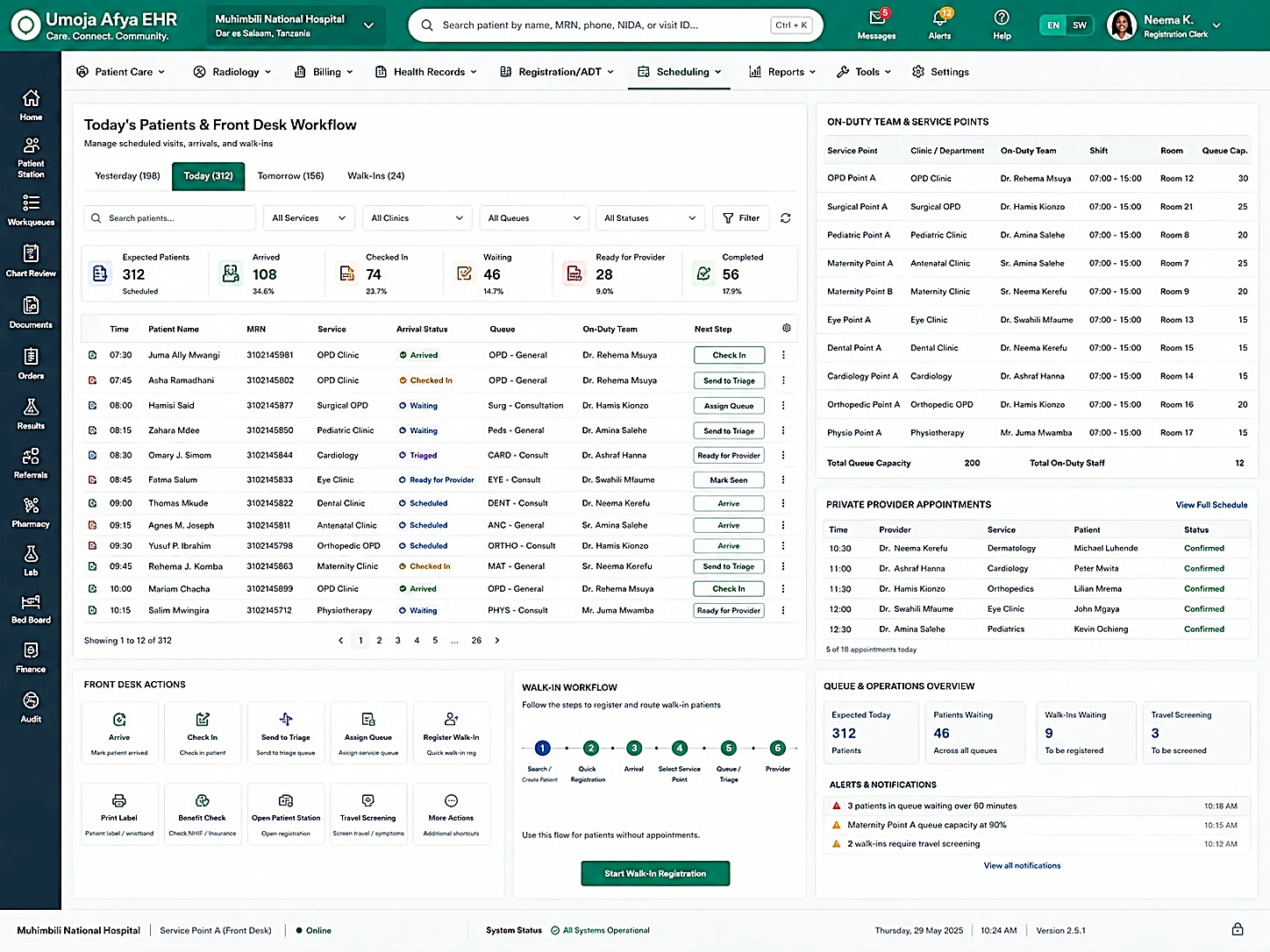
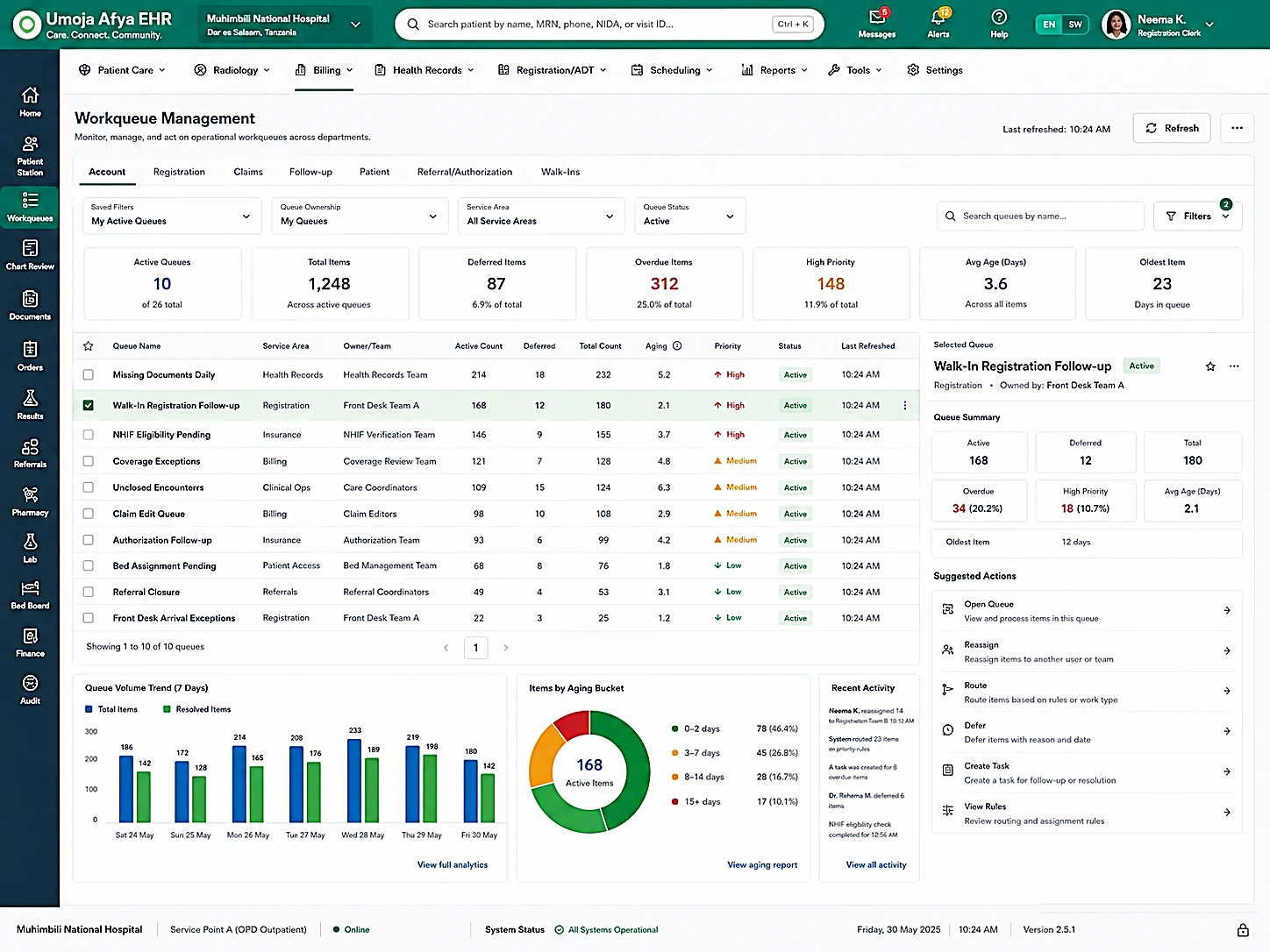
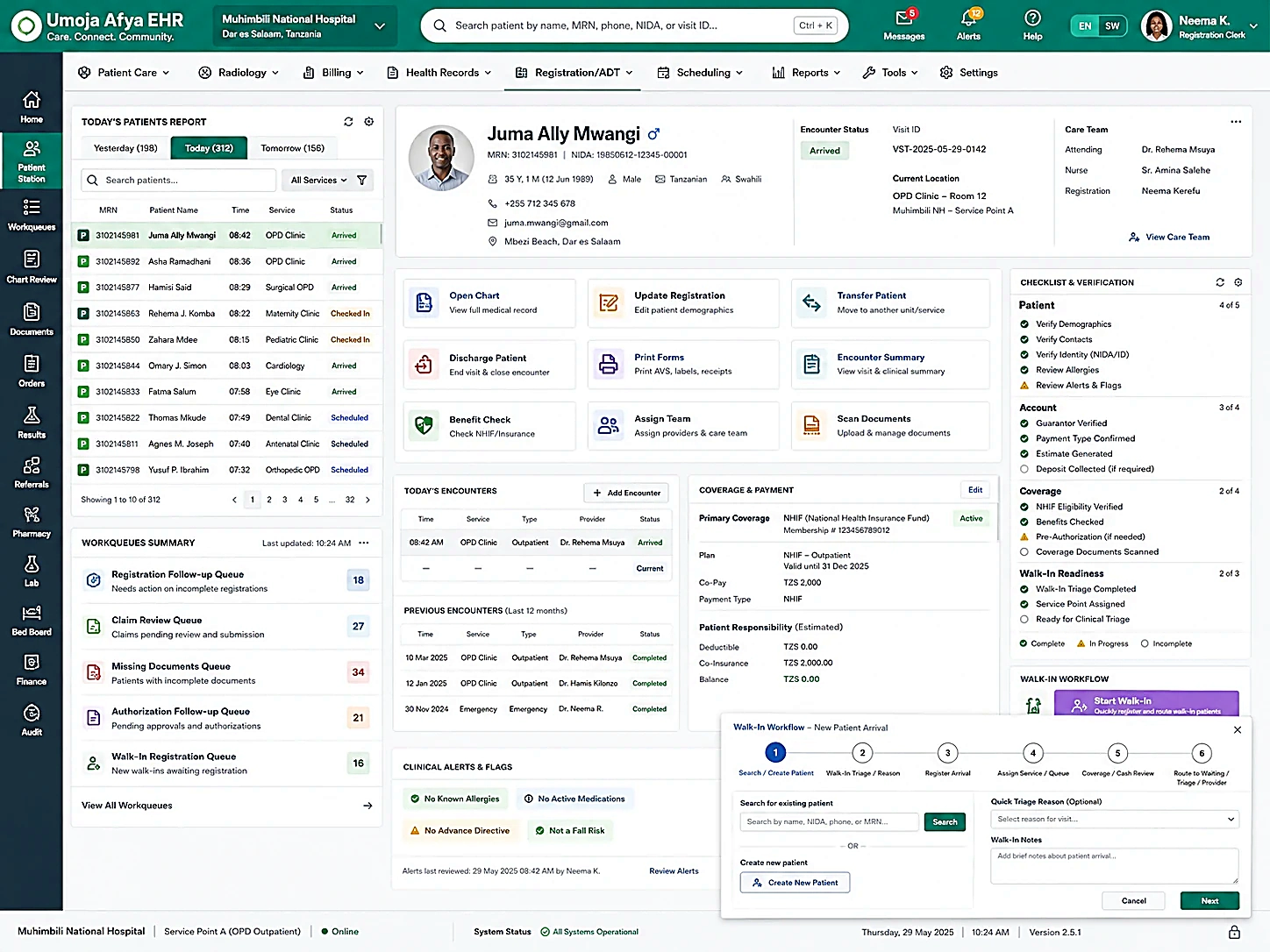
Real Umoja product screens • synthetic demonstration data • swipeable product tour feel
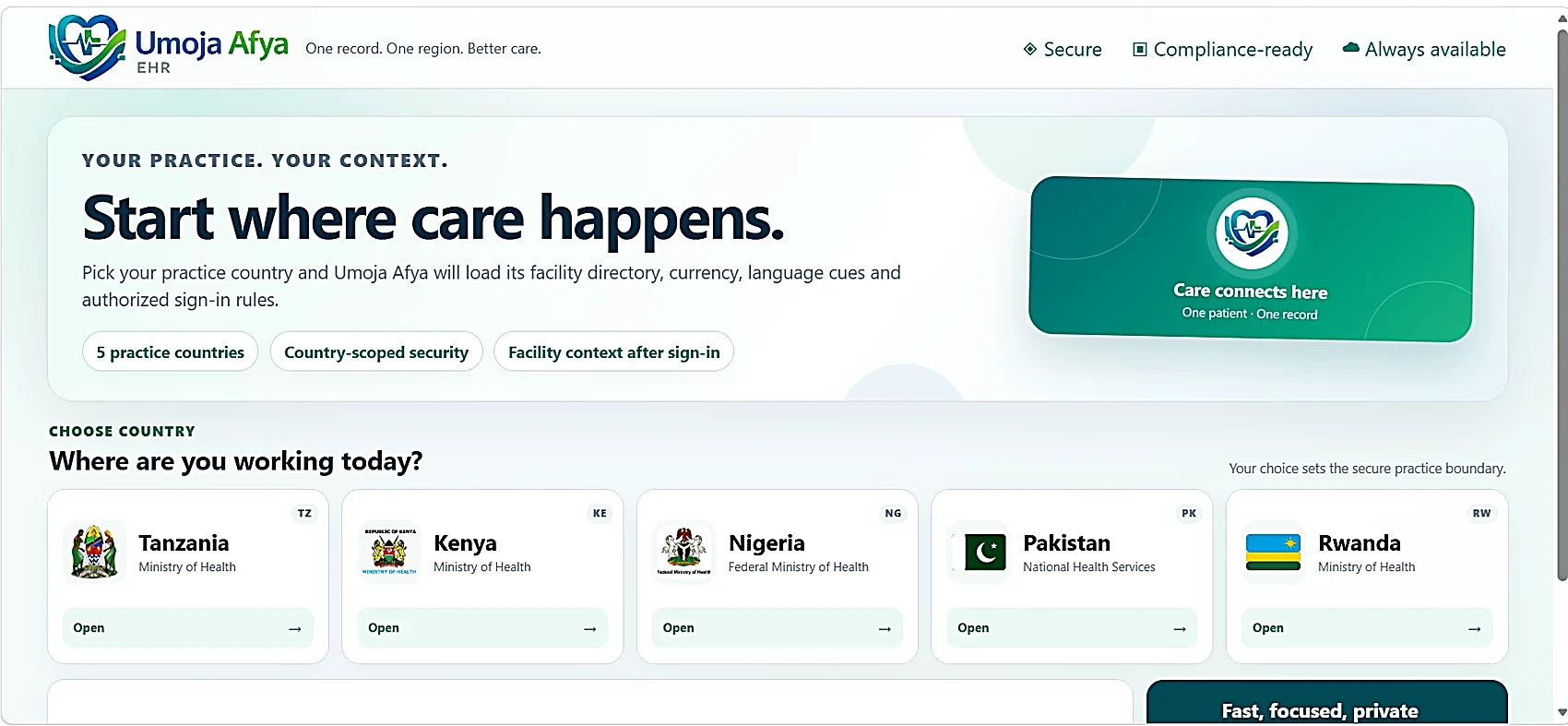
5 active BD marketsCurrent country tiles reflect ongoing business development—not deployment limits
Frontline-ready workflowsRegistration, queueing, encounters and patient context
Customer-shaped deliveryHosting, UI, workflows and support defined per project
1 live system to exploreJump into umojaehr.online and see the real thing
FHIR R4 interoperability
Dockerized deployment
Role-based access
Offline-capable workflows
Multi-facility architecture
Customer-chosen hosting
No per-user pricing
Current market-development footprint
The country tiles show where conversations are happening—not where Umoja is allowed to work.
The current demonstration highlights Tanzania, Kenya, Nigeria, Pakistan and Rwanda because there is ongoing business development for Umoja Afya EHR in those markets. They are examples of localization, not geographic restrictions.
Umoja can be customized and deployed in any country. Branding, terminology, language, currency, facility structures, workflows, national identifiers, reporting, interoperability targets, hosting architecture and security controls can be configured around the deploying organization and jurisdiction.
Country localization
Workflow configuration
Customer-chosen hosting
Local integration strategy
Why Umoja
Finally, healthcare software with range.
Umoja is for organizations that want enterprise-grade capability without bland SaaS lock-in—more control over deployment, sharper customization, clearer workflows and a commercial model that does not punish team growth.
Customizable UI/UX & workflows
Adapt screens, forms, navigation, terminology, roles, alerts and clinical workflows around how your organization actually delivers care.
Deployment your way
Customer-owned infrastructure, private cloud, public cloud, dedicated Linux VPS, government infrastructure or hybrid architecture.
Post-handover retainment
Take full operational control after handover, or keep Umoja engaged under a separately scoped support and retainment agreement.
Upgrades by request
New modules, workflows, integrations, redesigns and feature requests are reviewed, scoped, costed, approved, built and released as needed.
Platform acquisition
For organizations that want more than a software license, the platform can be discussed as a strategic technology acquisition.
Direct access to the live EHR
See the real hosted demonstration and evaluate the current experience rather than relying only on a brochure.
Open umojaehr.onlineOne longitudinal record
The EHR should follow the patient journey—not software module boundaries.
Registration, clinical assessment, orders, diagnostics, medication management, admission, discharge and follow-up should connect around one record with role, facility and audit context preserved.
Explore Platform Workflows01
Register
Identity
02
Assess
Triage + notes
03
Order
Lab + imaging
04
Treat
Pharmacy + eMAR
05
Transition
Admit + discharge
Real product screens
Real product energy. Real workflow density.
The visuals below are real Umoja interface screens using synthetic demonstration data. The goal is not to look generic—it is to feel modern, operational and ready for real healthcare complexity.
Provider documentation
Speak the note. Keep your attention on the patient.
Umoja supports provider-focused audio-to-text documentation through a separately containerized, self-hosted transcription service. Clinicians can dictate clinical content and use the resulting text as part of the documentation workflow instead of typing every word from scratch.
Provider dictation
Audio → text
Self-hosted transcription
No required paid transcription SaaS
Positioned as speech-to-text clinical documentation—not continuous ambient capture. The final note remains subject to provider review, editing and organizational documentation policy.
A faster path from conversation to chart.
01
Dictate
Provider records the clinical narrative or note content.
02
Transcribe
The self-hosted transcription service converts the audio into editable text.
03
Review & sign
The provider reviews, corrects and completes documentation under the organization’s clinical policy.
Pricing philosophy
Scale your care team—not your license bill.
Umoja does not use per-user or per-account pricing. Commercial scope is based on the implementation itself: facilities, modules, workflow complexity, integrations, migration, infrastructure, training and support.
See Engagement Model505005,000
✓
No per-user licensingAdd clinicians, nurses and operational staff without a seat meter.
✓
No account penalty for growthPricing is tied to project scope and services—not how many people need to log in.
✓
Transparent change requestsEnhancements and upgrades are separately scoped and costed before work begins.
Deployment freedom
Your infrastructure. Your security model. Your choice.
The customer chooses where Umoja runs and which security, data residency, backup, disaster recovery and operational requirements apply to the deployment.
Customer-Owned Infrastructure
Deploy into infrastructure controlled by your organization.
Private / Public Cloud
Use a customer-selected cloud provider and jurisdiction where appropriate.
Dedicated Linux VPS
A practical option for smaller or regional deployments requiring isolation and control.
Government Infrastructure
Support national or regional architecture under government control.
Hybrid Deployment
Combine cloud and local infrastructure where operational needs require it.
Managed Deployment
Retain implementation and operational support under a separately scoped agreement.
Internet / Users
→
HTTPS / TLS
→
Traefik
→
Docker Network
→
FastAPI App
→
PostgreSQL
The current hosted demonstration uses a Linux VPS, Docker / Docker Compose, Traefik and PostgreSQL. Umoja also includes a separately containerized, self-hosted speech-to-text service for provider dictation and audio-to-text clinical documentation workflows.
Security & compliance
Security is architecture—not a badge.
Umoja is designed to support healthcare organizations building HIPAA-regulated and SOC 2-oriented control environments. Final compliance depends on the full deployment: infrastructure, policies, identity, configuration, agreements, monitoring and operations.
See Security ArchitectureWe do not represent Umoja as “HIPAA certified” or “SOC 2 certified” without the corresponding organizational controls and independent attestation.
Role-based accessControl functions and records by role, facility and context.
Audit loggingSupport traceability of sensitive actions and operational access.
TLS encryptionHTTPS and customer-selected certificate / edge architecture.
Password securityStrong password hashing and configurable authentication controls.
Environment separationTraining, demo and production environments should remain isolated.
Offline protectionEncrypted offline-capable workflows with reauthentication before sync.
Container isolationNon-root/read-only patterns and service separation where configured.
Customer-controlled hostingChoose infrastructure, jurisdiction and operational controls.
Interoperability
Connected care needs connected systems.
Umoja includes a FHIR R4 starter service and interface architecture intended to support integration with diagnostics, devices, national systems and other healthcare applications.
FHIR R4REST APIsInterface outboxLab-readyPACS/RIS-readyNational-system adapters
“Own the workflow. Own the infrastructure. Own the future of your health data.”Umoja Afya EHR product philosophy
Strategic acquisition
Don't just license your EHR. Own it.
Organizations, investors, hospital groups, implementation firms and governments can inquire about acquiring the platform as a technology asset, including transferable source code, deployment architecture, UI/UX assets, workflow foundation and associated IP that can legally be transferred.

Clinical Practice Lab
Real workflows. Fictional patients. Practical EHR experience.
The planned Clinical Practice Lab turns the same workflow philosophy into a free practice environment for medical, nursing, pharmacy, allied-health and informatics students using synthetic patient data.
Explore the Student Vision1
Students practice free
Chart review, documentation, orders, results, eMAR and handoff.
2
Faculty assign scenarios
Structured cases, guided tasks and competency feedback.
3
Universities buy institutional tools
Private cohorts, faculty dashboards, analytics, SSO and support.
4
Hospitals gain EHR-ready talent
Training becomes an adoption and workforce-readiness engine.
Let's build the EHR your organization actually needs.
See the live product, discuss a deployment, explore institutional training, or start a conversation about acquiring the platform.